Rhona Kerr, SELA Cohort 2015
Over the course of my 8-week placement I have been working at BuroHappold in their Leeds office. BuroHappold is an international engineering consultancy specialising in designing urban environments, transit hubs, city districts and entire cities. The company is known for creating innovative solutions to some of the globe’s most iconic infrastructure. Think; the Millennium Dome, the Olympic Stadium and of course Sheffield’s own Winter Gardens.
I have been working within the structures department and the project I have been working on is called Angel Gardens, which is part of the NOMA redevelopment project based in Manchester. Once complete, the building will be the third tallest structure in Manchester city centre, altering the skyline of the city. It will be situated next to One Angel Square, the award winning CO-OP headquarters, which was a project previously undertaken by BuroHappold and awarded BREEAM Outstanding status, as well as multiple awards.
Throughout my placement I have gained invaluable experience, learning how to design tall buildings. This was a rare opportunity, as tall buildings are infrequently built within the UK.
I learnt to use a lot of new software in order to do the analysis of both the ground floor slab and the shear walls within the tower core. My main duties have been looking at the reinforcement within both the ground level slab and within the core of the tower. This has meant analysing the deflection, the stresses and the cracking within the concrete to check it is within tolerance. I have also been responsible for designing the required reinforcement within the slab, doing punching shear calculations, as well as hand calculations to check the forces and moments within the single spanning slabs and the beams on the ground floor.
Working on one project has allowed me to gain an in-depth understanding of how all the components of a project fit together. I have witnessed how the structures team interacts with other departments, such as Geotechnical engineers to bring the project together. Although I have been working on only one project throughout my time in the office, I have had the chance to hear about the diverse range of projects Burohappold undertakes.
The extra activities provided is one of the reasons I have enjoyed working at BuroHappold so much this summer. I have been allowed to attend CPDs and structures club that have given me useful experience allowing me to constantly gain more knowledge about the industry. One particular event, which sticks in my mind, was a lunchtime structures club. The topic of the day- How close can you pile next to an existing building? The answer obviously includes many different factors: ground conditions, existing foundations, size of equipment etc. After a detailed discussion with everyone from the team inputting his or her previous experience and knowledge it was decided that for this case the answer was 1.5 metres.
Events like this created a sociable working environment which was perfect for a placement student with many questions! I am very thankful that completing a placement is part of the SELA scheme as I believe the experience will come in useful for the remainder of my degree course.
Monday, September 19, 2016

Tuesday, May 10, 2016
The UK Energy Trilemma
Elizabeth Rush, SELA Cohort 2014
On the 25th April, concluding an unbelievably prosperous two years as members of the 2014 cohort, the collection of 11 students set up for their final presentation on The UK Energy Trilemma.

The year long project began in October following the triumph of their previous project, the 2015 Bootcamp. Starting slowly the cohort were taught skills on infographics and causal loops that would ultimately be the conclusive dissemination of the project. Once the basic understanding of presentation was completed, then came the information. Over the year expert upon expert have lectured to the cohort with the likes of specialists in renewable energy, representatives from Siemens and ex-Members of Parliament talking about what technology is at the forefront of this wicked problem.

Working together with the insight given to us by these titans of industry gave us the tools we needed to tackle this project head on. We elected to divide sections of the work into energy sources and distribution , in turn giving these to pairs of members to critically analyse using all the assets we were fortuitously allowed. Breaking down powerpoints, recordings and handwritten notes into key points was an achievement in itself, but the information we gathered then had to be collated into a format that was simple and direct whilst maintaining the expert undertone that we were provided.

By the end of this process, members of the cohort talked confidently about how these elements affected the UK population and at this stage we were positive we were ready to present our findings. Enlisting the help of Robert (illustrator) he was able to transform the chaotic biro causal loops we handed over into intricately illustrated guides through the stressed problems and positives of the corresponding topic. These were made all the more dynamic after printing in full A0 which allowed the cohort to view the magnitude of what we had accomplished.

These posters were hung within the Diamond in preparation for the arrival of the SELA stakeholders, researchers and key speakers we had received over the course of the academic year. As we quietly discussed the finishing touches to our presentations our guests began to trickle in, who we greeted with friendly faces and welcomed back enthusiastically. Following our opening presentations and brief overview of each topic, we asked our guests to examine our findings more closely and ask any questions they had for us. This section they were evidently prepared for as each member was in the line of their challenging questions, although our extensive research supported an entertaining debate for student and professional alike. The closing statements of the evening allowed us to thank our many guests for their attendance and to summarise what challenges we encountered and what we expect to come. Met by nodding heads and an emphatic applause the evening concluded, an event that we feel epitomised our success as members of the Sheffield Engineering Leadership Academy.

On the 25th April, concluding an unbelievably prosperous two years as members of the 2014 cohort, the collection of 11 students set up for their final presentation on The UK Energy Trilemma.

The year long project began in October following the triumph of their previous project, the 2015 Bootcamp. Starting slowly the cohort were taught skills on infographics and causal loops that would ultimately be the conclusive dissemination of the project. Once the basic understanding of presentation was completed, then came the information. Over the year expert upon expert have lectured to the cohort with the likes of specialists in renewable energy, representatives from Siemens and ex-Members of Parliament talking about what technology is at the forefront of this wicked problem.

Working together with the insight given to us by these titans of industry gave us the tools we needed to tackle this project head on. We elected to divide sections of the work into energy sources and distribution , in turn giving these to pairs of members to critically analyse using all the assets we were fortuitously allowed. Breaking down powerpoints, recordings and handwritten notes into key points was an achievement in itself, but the information we gathered then had to be collated into a format that was simple and direct whilst maintaining the expert undertone that we were provided.

By the end of this process, members of the cohort talked confidently about how these elements affected the UK population and at this stage we were positive we were ready to present our findings. Enlisting the help of Robert (illustrator) he was able to transform the chaotic biro causal loops we handed over into intricately illustrated guides through the stressed problems and positives of the corresponding topic. These were made all the more dynamic after printing in full A0 which allowed the cohort to view the magnitude of what we had accomplished.

These posters were hung within the Diamond in preparation for the arrival of the SELA stakeholders, researchers and key speakers we had received over the course of the academic year. As we quietly discussed the finishing touches to our presentations our guests began to trickle in, who we greeted with friendly faces and welcomed back enthusiastically. Following our opening presentations and brief overview of each topic, we asked our guests to examine our findings more closely and ask any questions they had for us. This section they were evidently prepared for as each member was in the line of their challenging questions, although our extensive research supported an entertaining debate for student and professional alike. The closing statements of the evening allowed us to thank our many guests for their attendance and to summarise what challenges we encountered and what we expect to come. Met by nodding heads and an emphatic applause the evening concluded, an event that we feel epitomised our success as members of the Sheffield Engineering Leadership Academy.

Thursday, March 24, 2016
Get a Gripple
Katie Atkins, SELA Cohort 2015
On the 9 March, SELA’s 2014 and 2015 cohorts had the opportunity of attending a visit to the Loadhog and Gripple site in Sheffield – manufacturers of transit packaging and wire tensioners respectively. Both companies are part of GLIDE, an employee owned company that represents all its shareholders. The company is based on an innovative and creative business model not often seen in the world of engineering, and therefore provided a unique insight in a different style of management. Gordon Macrae, the Special Projects Manager at Loadhog and Gripple delivered a talk outlining their ethos and what to expect from the company.
A tour around the offices and factory floor allowed all the students to see the scope of the company and their unique design process in practice. Ideas boards, suspended art installations and interactive meeting spaces were all present and integrated into the office space. Although, for many of the students the expansive factory floor provided the greatest interest from a technical engineering perspective. Finally, following encouragement from Gordon many of us suggested methods of improvement throughout the design stages and factory processing, some of which were taken more seriously than others.
All members of SELA would like to thank those at Gripple and Loadhog that welcomed us and especially to Gordon Macrae for taking the time to speak with us.
Tuesday, October 13, 2015
An Excellent Scolarship for an Excellent Student
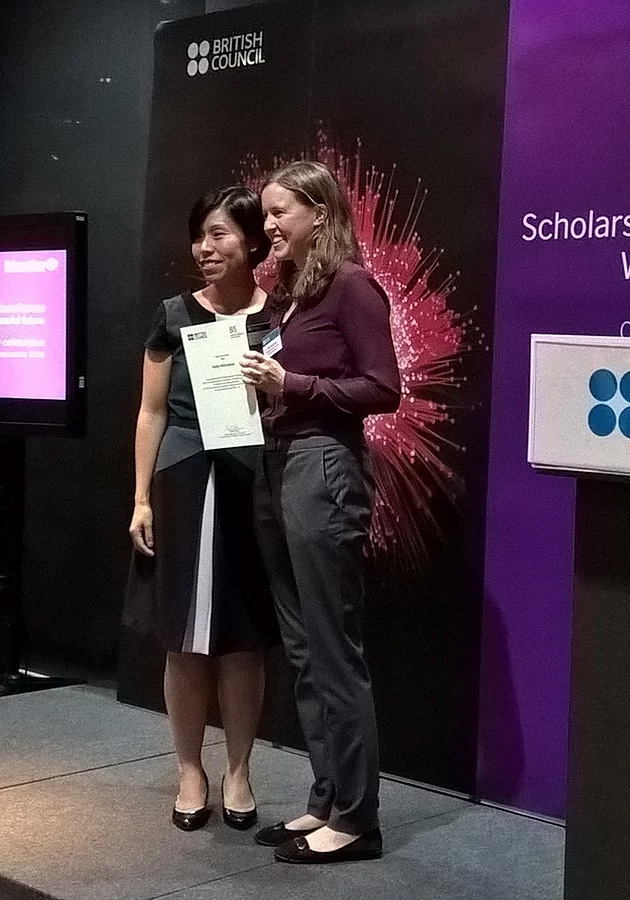
The Scholarship for Excellence is awarded by the Hong Kong British Council for UK students studying in there for one semester to one year. The purpose of the scholarship is to promote British-Hong Kong relations. The Scholarship is offered by the Department for Business, Innovation and Skills (BIS) are worth up to £3,000, depending on how long the recipients stay in Hong Kong. The Hong Kong British Council says, "By going to Hong Kong, students can experience the vibrant East-West lifestyle of the former British territory and now Special Administrative Region of China, and learn about a region of vital economic and cultural importance to the UK."
SELA member Holly Nicholson is one such student and is one of around 13 other students from UK universities, (including another from Sheffield!) studying at Hong Kong University and Chinese University of Hong Kong who have been awarded the scholarship this year.

Holly says, "I heard about the scholarship at one of the Global Opps meetings; I applied, and after a Skype interview, found out I had been successful. Actually, I nearly forgot about the interview, because it was the morning of one my final exams - I was on my way to the library when I suddenly remembered and ran back! Fortunately I wasn't late! During the interview I was asked about what other things I did alongside my studies and I was able to talk about working as part of the SELA team, and taking part in the Spaghetti Bridge Challenge [organized by Civil Engineering].
"Whenever I see an opportunity like this, I always apply. I apply for everything. We have a saying in the North East 'shy bairns get nowt', which translates as 'shy children get nothing' but we usually use it to mean, 'if you don't ask, you don't get'! In my experience, keep asking, keep trying, keep applying, and you will reap the reward eventually!"
More information on the scholarship can be found here: www.britishcouncil.hk/en/study-uk/scholarships/excellence.
Wednesday, September 9, 2015
Summer Placement: Materials Science & Engineering, University of Sheffield
 Sam Cheney has been working in the Department of Materials Science and Engineering at The University of Sheffield carrying out research into Cure monitoring of Electrically cured carbon fibre ply drops. Here's Sam's story:
"I have been using a novel way of curing carbon fibre panels which uses electrical current to heat up a panel and cure the resin. I have been investigating in particular how heat is transferred when there is a decrease in the number layers of carbon fibre between the connecting plates and finding out if there will be any areas of concentrated heat, ideally there will be no change and the panel will cure evenly, however, from testing this theory I have found that heat is transferred slower in thicker sections so I have started investigating solutions and my end aim for the placement is to solve this problem and move on to more complicated ply drop structures.
"After the project I hope to be a contributor to a research paper and become published in a journal.
"I am enjoying my placement, I think the thing I most enjoy is the fact that I am actually making progress on a subject that is currently not fully understood.
"I have been using a blow torch to melt solder and create connecting terminals and the other day I ended up setting fire to the wire, the carbon fibre panel and the tool I was using! Thankfully there was only a small amount of black smoke and I managed to put it out without setting off any fire alarms!"
Tuesday, September 8, 2015
Summer Placement: AMRC with Boeing

I am currently completing a ten week placement within the Process Monitoring and Control group at The University of Sheffield’s Advanced Manufacturing Research Centre (AMRC) with Boeing.
The AMRC started as a collaborative research initiative between the University of Sheffield and Boeing, but has now grown to host over 80 member companies including Airbus, Rolls-Royce, BAE Systems and IBM.
These companies work together in a range of groups in order to develop the next wave of high value manufacturing technologies in readiness for the future of engineering industry. The groups cover machining, composites, medical and nuclear research, design and prototyping, structural testing and automation.
The opportunity for my placement at the AMRC arose from one of our SELA workshops during which a senior Rolls-Royce engineer shared with us his thoughts and perspectives on leadership within his job role at the AMRC. At the end of this workshop, I was keen to follow up the opportunity and was lucky enough to find myself being interviewed the very next morning for a 10 week summer placement within the Process Technology Group at the AMRC. The group focuses research on measurement, computation and autonomous control challenges faced in advanced manufacturing processes.
My project is to design and develop both the software and the hardware for a wireless sensor network which can provide a drop in solution for monitoring the temperature of multiple machine tools on the AMRC Factory of the Future workshop floor. The system I have designed uses the popular Arduino and Raspberry Pi platforms alongside inexpensive ZigBee radios which together provide a compact and low cost solution for wireless data acquisition.
After researching and developing the design at the start of the project, two wireless units have recently been installed on CNC machine tools as a proof of concept system. Each unit has multiple temperature sensors which are now recording data from locations such as the main spindle motor housing, the machine bed, the coolant fluid tank and the ambient workshop temperature.
I hope that in the future, the system developed for this project is expanded to work with a range of Arduino-compatible sensors, in order to allow multiple process parameters to be wirelessly monitored and recorded. This data could then be used to help identify machining anomalies and to improve manufacturing processes to always work at optimum conditions.
As a Chemical Engineering student, I have found this placement very rewarding as it has enabled me to expand my knowledge of programming, wireless communication, electronics and process monitoring in a multidisciplinary engineering environment. This has been a great opportunity to apply my engineering skills in a new context, whilst taking on the responsibility for developing, delivering and presenting my project against a number of design criteria; on time and within budget.
AMRC Project Manager, Simon Hogg has been supervising Robin’s placement. He said: “Robin has been working alongside our own engineers and has managed to adapt his skill set to allow us to progress wireless sensor collection.
“We have adapted the scope of his project dynamically during his placement to fit it to the needs of multiple internal customers including manufacturing engineers and IT managers.”
Tuesday, September 1, 2015
Summer Placement: Alan Wood & Partners

I have done such a variety of things since starting. I have designed beams for house renovations, making them open planned. I have done the structural designs on an Orangery, designed the gate, gate post and foundations for a college, and have done the architectural drawings for a large office/warehouse for a big company. I have most recently finished helping do the structural designs for the renovation of the student’s union at the University of Hull. I am currently working on a large extension for a three story house. The best part has been what I have been doing at the moment. I have been given a fresh project, to do the structural designs on a large cottage that is going to be built, rather than be altered.
Once I have finished my placement, I aim to have a better understanding of the real world engineering problems and solutions, and be able to tackle problems with confidence and ease from the skills I have learnt throughout the summer.
Once I have finished my placement, I aim to have a better understanding of the real world engineering problems and solutions, and be able to tackle problems with confidence and ease from the skills I have learnt throughout the summer.
I have been thrown in the deep end and have managed to keep my head above water! I have been given my own projects, been trusted to complete drawings to a standard which are to be used in the construction process, and have been given responsibility to contact and consult with both clients and contractors when working on their project. I am working as if I was employed here at the company, rather than a student that has been hired for a summer placement.
The amount of tea that everyone goes through here is incredible. I think I know where the majority of tea in the UK is consumed. And there are only 6 of us here.
The amount of tea that everyone goes through here is incredible. I think I know where the majority of tea in the UK is consumed. And there are only 6 of us here.
Subscribe to:
Posts (Atom)